
The State of REITs: January 2026 Edition
- The REIT sector closed out 2025 with a tough December (-1.48%) and finished the year with a total return of-3.57%.
- Small caps (+0.51%) eked out a small gain in December, while mid caps (-1.77%), large caps (-2.55%), and micro caps (-3.88%) fell at the close of the year.
- 42.04% of REIT securities had a positive total return in December, with only 38.36% in the black for the full year.
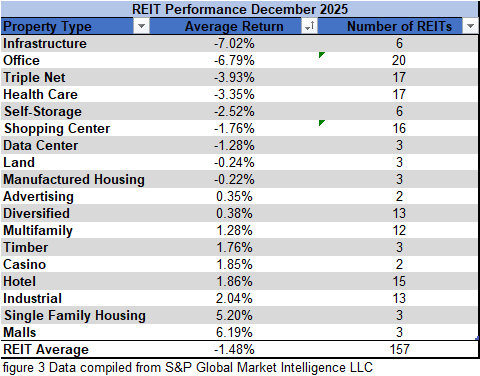
- 50% of REIT property types averaged positive returns in December. Malls (+6.19%) and Single Family Housing (+5.20%) saw strong gains while Infrastructure (-7.02%) and Office (-6.79%) struggled.
- The average REIT NAV discount widened from -14.84% to -17.49% during December. The median NAV discount narrowed slightly from -18.48% to -18.45%.
REIT Performance
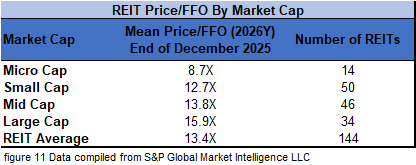
REITs finished 2025 in the red with a -1.48% December total return. REITs underperformed the broader market, falling short of slightly stronger returns from the Dow Jones Industrial Average (+0.92%), S&P 500 (+0.06%) and NASDAQ (-0.09%). The market cap weighted Vanguard Real Estate ETF (VNQ) fell short of the average REIT in December (-2.24% vs. -1.48%), but substantially outperformed over the full year (+3.26% vs. -3.57%). The spread between the 2026 FFO multiples of large cap REITs (15.9x) and small cap REITs (12.7x) narrowed in December as multiples contracted 0.3 turns for large caps and 0.1 turns for small caps. Investors currently need to pay an average of 25.2% more for each dollar of FFO from large cap REITs relative to small cap REITs. In this monthly publication, I will provide REIT data on numerous metrics to help readers identify which property types and individual securities currently offer the best opportunities to achieve their investment goals.
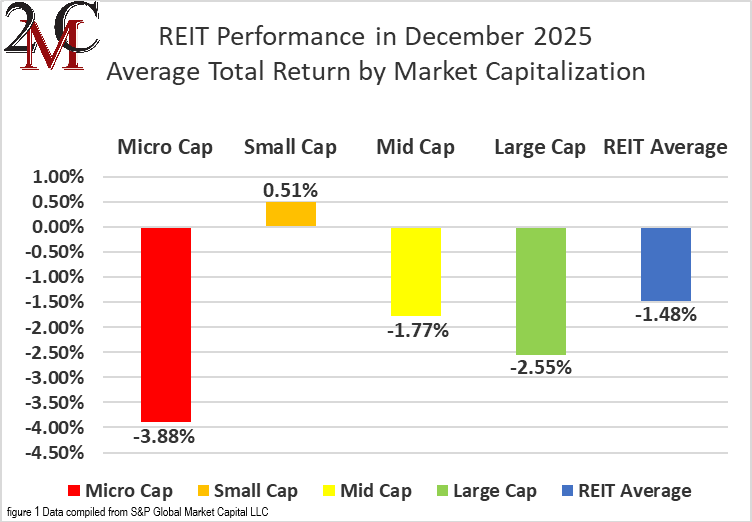
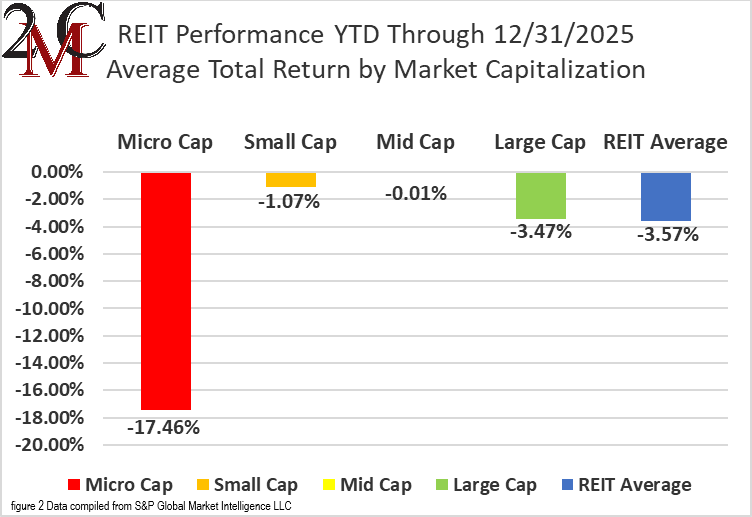
In December, only small caps (+0.51%) averaged a positive total return. Mid caps (-1.77%), large caps (-2.55%) and micro caps (-3.88%) all finished the final month of the year in the red. Over full-year 2025, small cap REITs outperformed large caps by 240 basis points.
9 out of 18 Property Types Averaged Positive Returns in December
Half of REIT property types averaged a positive total return in December, with a 13.22% total return spread between the best and worst performing property types. Malls (+6.19%) and Single Family Housing (+5.20%) led the REIT sector, while Infrastructure (-7.02%) and Office (-6.79%) had the lowest average total returns.
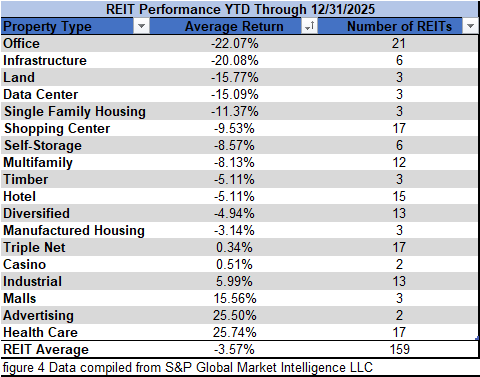
Office (-22.07%), Infrastructure (-20.08%), Land (-15.77%), Data Centers (-15.09%) and Single Family Housing (-11.37%) all averaged double-digit negative total returns in 2025. Health Care (+25.74%), Advertising (+25.50%) and Malls (+15.56%) were the top performing REIT property types over the full year.
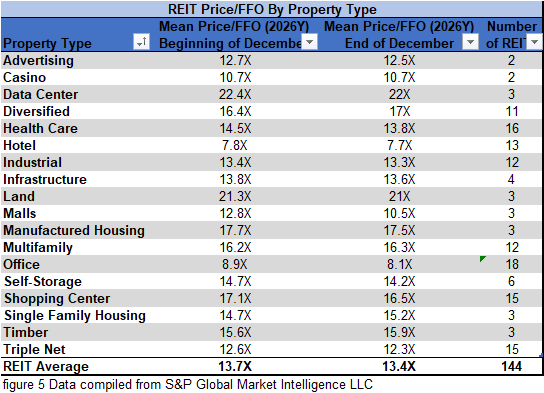
The REIT sector as a whole saw the average P/FFO (2026Y) decrease from 13.7x to 13.4x during December. 22.2% of property types averaged multiple expansion, 72.2% averaged multiple contraction and 5.6% saw multiples hold steady. Data Centers (22x), Land (21x), Manufactured Housing (17.5x) and Shopping Centers (16.5x) currently trade at the highest average multiples among REIT property types. Hotels (7.7x) and Office (8.1x) are the only property types that average single-digit FFO multiples.
Performance of Individual Securities
Paramount Group (PGRE) was acquired by Rithm Capital Corp. on December 19th in and all cash transaction for $6.60/share. December 18th was the final day of trading.
Alexander & Baldwin (ALEX) (+34.29%) was the best performing REIT in December with share price gains fueled by the December 8th news that ALEX will be acquired by Blackstone Real Estate, MW Group and DivcoWest for $21.20/share. The merger is expected to close during Q1 2026 at which point ALEX will be taken private.
Fermi (FRMI) (-51.49%) saw steeper losses than any other REIT in December. The share price collapsed after the December 12thnews that its first prospective tenant canceled a $150M agreement. Although Fermi has reported that they remain in talks with that prospective tenant as well as others, no new agreement has yet been reached.
42.04% of REITs had a positive total return in December with 38.36% in the black over the full year. REITs averaged a -3.57% total return in 2025, which is 727 basis points below the +3.70% return for the REIT sector in 2024.

Dividend Yield
Dividend yield is an important component of a REIT’s total return. The particularly high dividend yields of the REIT sector are, for many investors, the primary reason for investment in this sector. As many REITs are currently trading at share prices well below their NAV, yields are currently quite high for many REITs within the sector. Although a particularly high yield for a REIT may sometimes reflect a disproportionately high risk, there exist opportunities in some cases to capitalize on dividend yields that are sufficiently attractive to justify the underlying risks of the investment. I have included below a table ranking equity REITs from highest dividend yield (as of 12/31/2025) to lowest dividend yield.

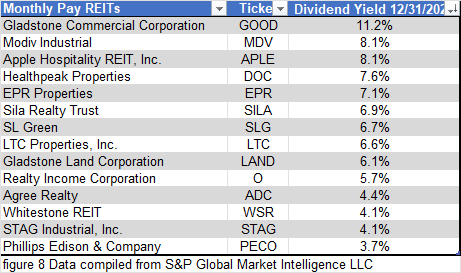
Although a REIT’s decision regarding whether to pay a quarterly dividend or a monthly dividend does not reflect on the quality of the company’s fundamentals or operations, a monthly dividend allows for smoother cash flow to the investor. Below is a list of equity REITs that pay monthly dividends ranked from highest yield to lowest yield.
Economic Health
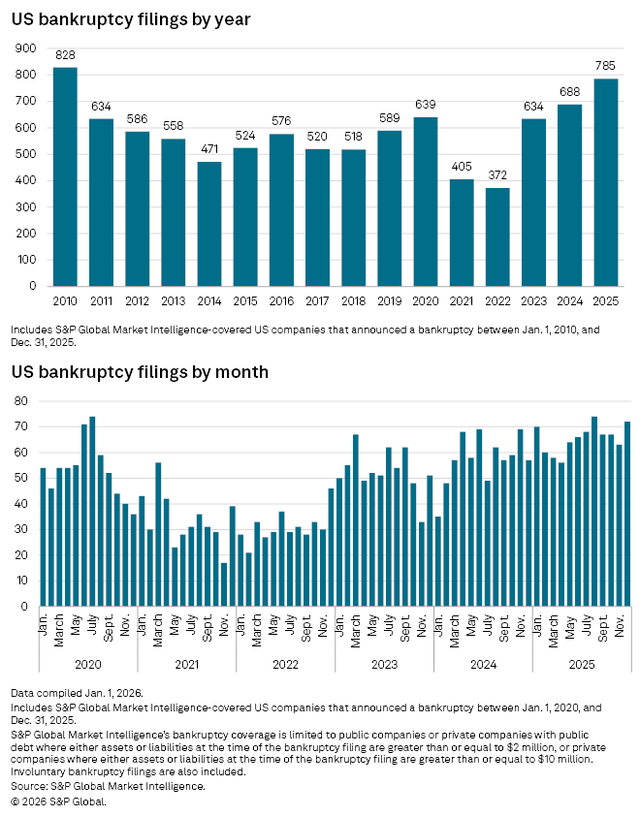
Corporate bankruptcies in December rose month-over-month from November and reached the 2nd highest monthly total of the past 5 years. In 2025 the number of bankruptcies increased for the 3rd year in a row and reached the highest annual level since 2010. The trajectory of bankruptcies in 2026 will heavily depend on the pace of rate cuts from the Fed. If rates come down materially throughout the year, it will open up opportunities for many companies to refinance at lower rates, improving profitability.
Valuation
REIT Premium/Discount to NAV by Property Type
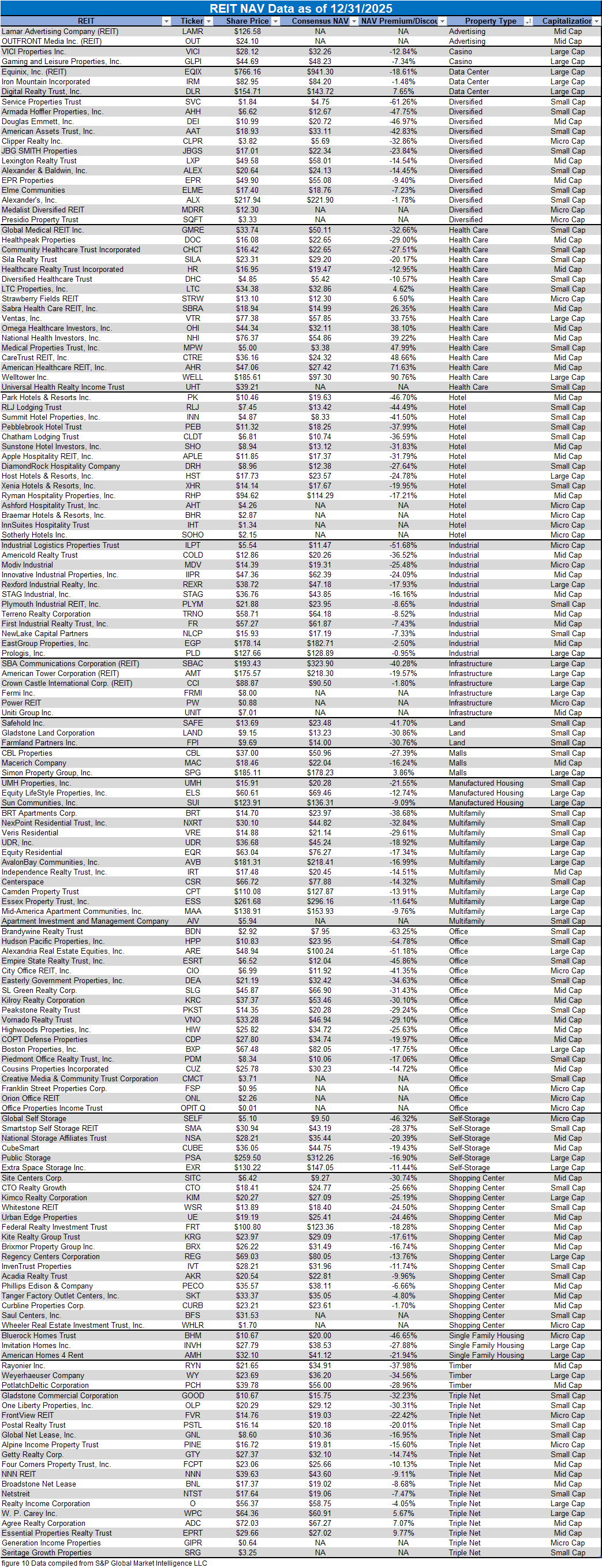
Below is a downloadable data table, which ranks REITs within each property type from the largest discount to the largest premium to NAV. The consensus NAV used for this table is the average of analyst NAV estimates for each REIT. Both the NAV and the share price will change over time, so I will continue to include this table in upcoming issues of The State of REITs with updated consensus NAV estimates for each REIT for which such an estimate is available.
Takeaway
The large cap REIT premium (relative to small cap REITs) widened in December and investors are now paying on average about 25% more for each dollar of 2026 FFO/share to buy large cap REITs than small cap REITs (15.9x/12.7x – 1 = 25.2%). As can be seen in the table below, there is presently a strong positive correlation between market cap and FFO multiple.
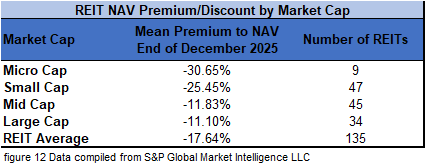
The table below shows the average NAV premium/discount of REITs of each market cap bucket. This data, much like the data for price/FFO, shows a strong, positive correlation between market cap and Price/NAV. The average large cap (-11.10%) and mid cap REIT (-11.83%) trade at low double-digit discounts to consensus NAV. Small cap REITs (-25.45%) trade around 3/4 of NAV while micro caps (-30.65%) trade for a little over 2/3 of their respective NAVs.
REITs Enter 2026 at a Significant Relative Discount to the Broader Market and are Well Positioned to Outperform
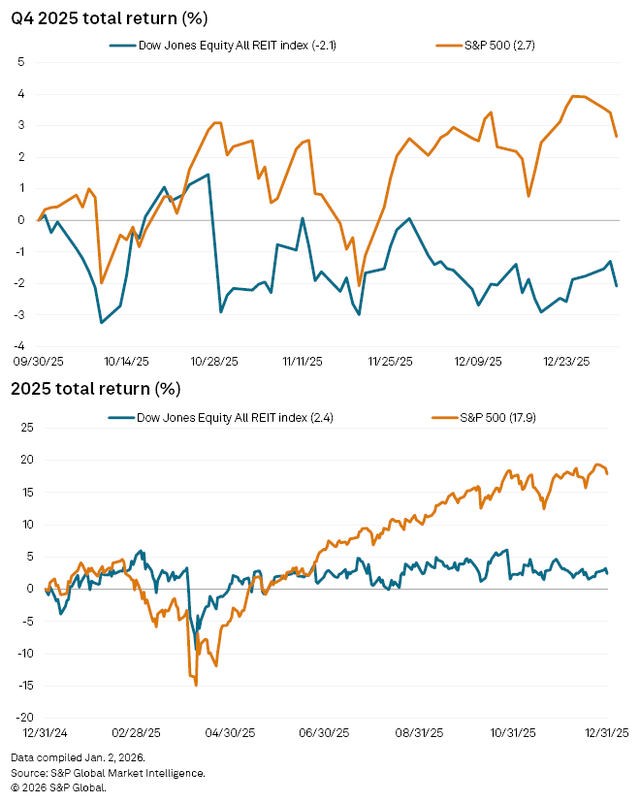
The REIT sector (-2.1%) fell 480 basis points short of the S&P 500 (+2.7%) in total return during Q4 2025. The underperformance was even more substantial over the full year as the REIT sector fell short of the S&P 500 by more than 1500 bps.
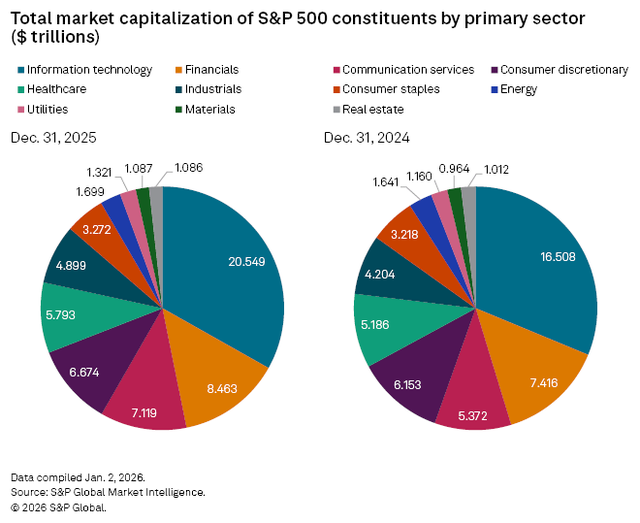
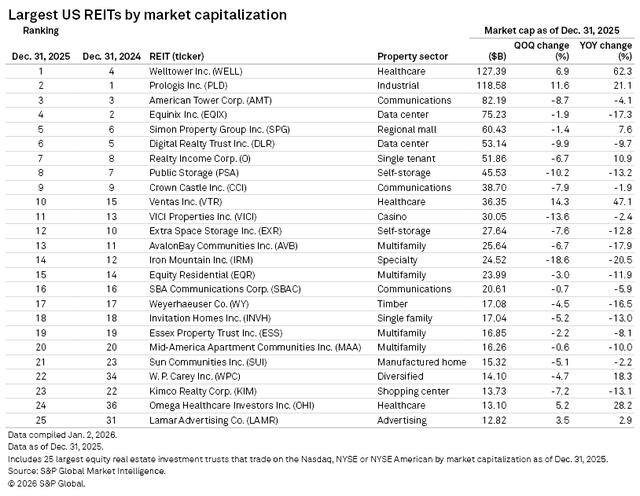
Due to significantly underperforming throughout the year, real estate finished 2025 as the smallest sector of the S&P 500.
While some S&P 500 companies saw solid earnings growth, much of the S&P’s huge share price surge over the past several years has come from multiple expansion. Multiples have expanded so much that the Shiller PE Ratio for the S&P 500 finished 2025 at the 2nd highest level ever. The only time that market pricing reached an even higher valuation extreme was the Dot Com Bubble, which burst so violently that multiples collapsed by about 2/3 over then next decade.
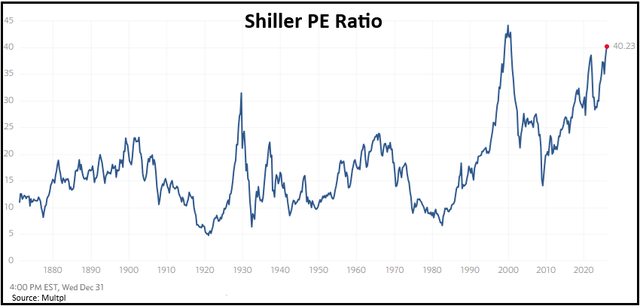
Although it is certainly possible that the current bubble could further inflate before popping, there is no historical precedent to suggest that such extreme valuation can be sustained. While the market is unlikely to collapse as severely as it did when the Dot Com Bubble burst, it is still very important to be aware that Investing into such a wildly overvalued market carries substantial risk.
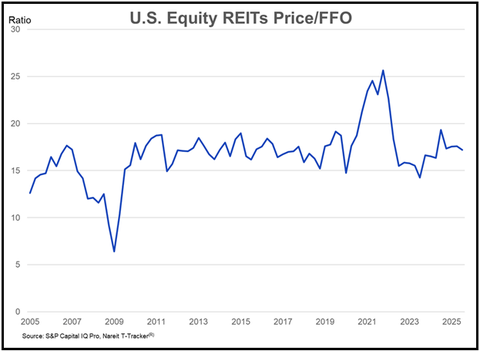
Thankfully, however, there are still opportunities to invest into stocks that are trading at reasonable and even opportunistic valuations. The REIT sector as a whole is currently trading right in line with historical norms and within the sector there are numerous REITs trading at substantial discounts to what their assets would sell for in the private market. As a result, REIT M&A is beginning to heat up.
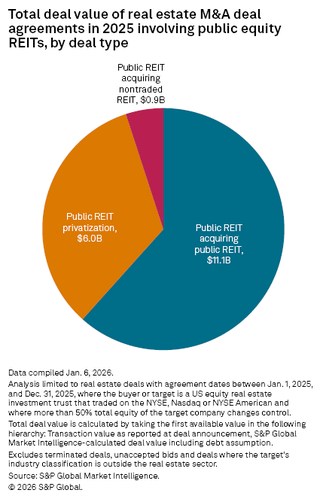
Discounted REITs have been targeted for acquisition by both larger public REITs and by private equity. The wide spread between discounted share price and NAV creates a scenario ripe for win-win M&A. It represents a lucrative opportunity for the acquiring entity to attain a large portfolio of quality real estate assets for less than fair value. It also presents an opportunity for the acquired REIT to sell for a price far above where they are currently trading.
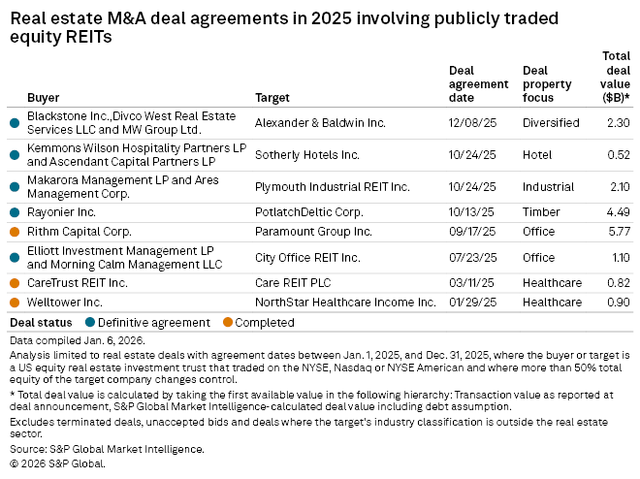
Takeout bids were already accepted in 2025 by City Office REIT (CIO), Paramount Group (PGRE), PotlatchDeltic (PCH), Plymouth Industrial REIT (PLYM), Sotherly Hotels (SOHO) and Alexander & Baldwin (ALEX). Whitestone REIT (WSR) rejected a takeout bid and may yet receive higher offers. With a litany of other quality REITs still trading at low multiples and wide discounts to NAV, there will likely be much more REIT M&A in 2026. The REIT sector as a whole is well positioned to outperform an overvalued S&P 500 this year and there is substantial alpha potential available to active managers who correctly identify REIT M&A targets and thus capture the upside between current price and acquisition price.
Important Notes and Disclosure
All articles are published and provided as an information source for investors capable of making their own investment decisions. None of the information offered should be construed to be advice or a recommendation that any particular security, portfolio of securities, transaction, or investment strategy is suitable for any specific person. The information offered is impersonal and not tailored to the investment needs of any specific person.
We cannot determine whether the content of any article or recommendation is appropriate for any specific person. Readers should contact their financial professional to discuss the suitability of any of the strategies or holdings before implementation in their portfolio. Research and information are provided for informational purposes only and are not intended for trading purposes. NEVER make an investment decision based solely on the information provided in our articles.
We may hold, purchase, or sell positions in securities mentioned in our articles and will not disclose this information to subscribers, nor the time the positions in the securities were acquired. We may liquidate shares in profiled companies at any time without notice. We may also take positions inconsistent with the information and views expressed on our website.
We routinely own and trade the same securities purchased or sold for advisory clients of 2MCAC. This circumstance is communicated to our clients on an ongoing basis. As fiduciaries, we prioritize our clients’ interests above those of our corporate and personal accounts to avoid conflict and adverse selection in trading these commonly held interests.
Past performance does not guarantee future results. Investing in publicly held securities is speculative and involves risk, including the possible loss of principal. Historical returns should not be used as the primary basis for investment decisions. Although the statements of fact and data in this report have been obtained from sources believed to be reliable, 2MCAC does not guarantee their accuracy and assumes no liability or responsibility for any omissions/errors
Commentary may contain forward-looking statements that are by definition uncertain. Actual results may differ materially from our forecasts or estimations, and 2MCAC and its affiliates cannot be held liable for the use of and reliance upon the opinions, estimates, forecasts, and findings in this article.
Through October 2021, The State of REITs was published exclusively on Seeking Alpha by Simon Bowler, Sector Analyst at 2nd Market Capital Services Corporation (2MCSC). Editions subsequent to October 2021 will be published on this website in addition to other platforms that may include Seeking Alpha. 2MCSC was formed in 1989 and provides investment research and consulting services to 2nd Market Capital Advisory Corporation. 2MCSC does not provide investment advice. 2MCSC is a separate entity but related under common ownership to 2nd Market Capital Advisory (2MCAC), a Wisconsin registered investment advisor. Simon Bowler is an investment advisor representative of 2MCAC. Any positive comments made by others should not be construed as an endorsement of the author's abilities to act as an investment advisor.
S&P disclosure: S&P Global Market Intelligence LLC. Contains copyrighted material distributed under license from S&P.
Discover more from 2nd Market Capital Advisory Corp
Subscribe to get the latest posts sent to your email.