
REIT Total Return: Heading into 2Q26
2026 began with a return to value investing. Many of the highfliers sold off materially while money poured back into value sectors like REITs. At the end of February, REITs were up substantially with the broader markets, and particularly momentum tech cooling off. In March, however, the Iran war took its toll on the entire market. The S&P 500 continued to suffer and REITs also fell, giving up some of their earlier gains.
REITs remain up year to date, but nowhere near as much as they were before the war. I think it is an interesting move because the mechanism by which the war impacts REITs is very indirect.
Compared to the S&P, which derives a large portion of revenues internationally, REITs are extremely domestic in nature. A few of the large-cap REITs like Prologis (PLD) and W.P. Carey (WPC) own properties in Europe and other countries, but the vast majority of REIT properties are in the U.S.
This makes their revenue streams relatively isolated from geopolitics. One of the most obvious financial implications of the Iran war is the surge in oil prices. REITs are also somewhat indifferent to oil. While a small number of REITs like Getty (GTY) are indirectly exposed to oil prices through their tenants selling gasoline, we anticipate minimal impact. Gas station tenants might have fractionally higher gas sales (as margins tend to stay a similar percentage of now slightly higher revenues), but this would be offset by lower inside sales to the extent consumer elasticity reduces frequency of refueling.
So, with REIT revenues isolated from both geopolitics and oil, why did the index move so much?
We suspect it is related to market expectations of the Fed. Regardless of how temporary the oil price spike might be, $100+ oil does have implications on near term price inflation since oil is used in the transportation of goods.
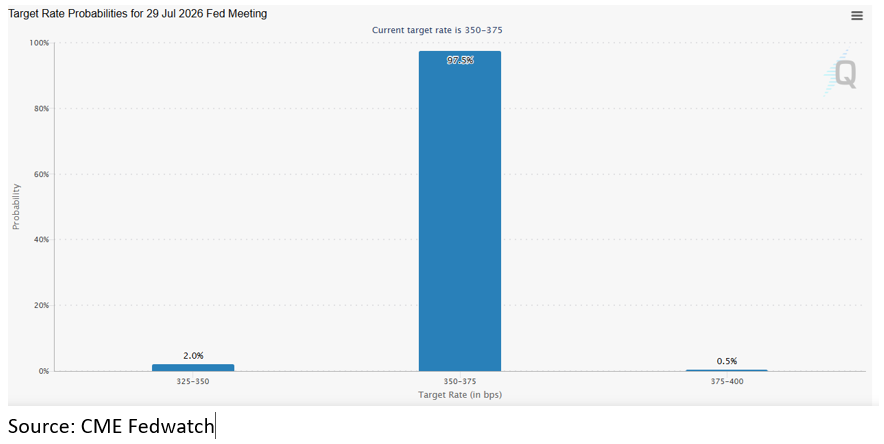
This upward pressure on inflation has destroyed the market’s hopes for a rate cut. It was previously anticipated that the Fed would cut rates by 25 basis points in July, but now the market is pricing in a 97.5% chance of rates holding steady.
REITs do not need a cut. Stable interest rates at around the level where they are now are healthy for long-term real estate fundamentals.
However, it would be consistent with the last decade for REITs to significantly overreact to interest rates in both directions. REITs got far too excited by the zero interest rates in 2021 and far too depressive about higher rates in recent periods. Thus, it does not surprise me that REITs dropped about 6% on expectations, changing from a probable July cut to a low probability of a July cut.
That said, I think it represents opportunity. REITs are trading quite cheaply on both NAV and earnings multiples. Through careful stock selection, we have been able to get even deeper value with an average P/FFO for the RTR portfolio of just 12.5X
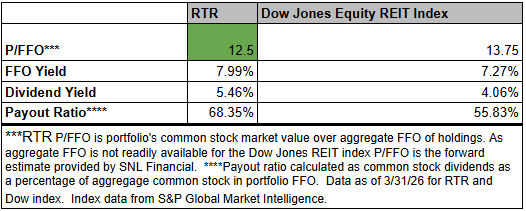
This affords a 5.46% dividend yield with a payout ratio of 68.35%.
There are 2 ways of achieving a high yield from real estate:
- Buying high-risk assets that naturally trade at a high yield.
- Getting extra yield through buying at a discount.
We do the latter.
Consider a real estate asset that normally has a 6% yield. If you buy that asset at 80% of value, it will have a 7.5% yield.
Nothing else will have changed. By buying at a discount, you simply get a higher return and arguably lower risk because less principal was put in relative to asset value.
That is essentially what RTR does. The average price to NAV of the portfolio is 78%. The companies in which we invest own high quality properties that consistently trade in the private market at high valuations.
The oddity that exists today in the stock market is that the public companies that own these assets are trading far below the value of the assets.
The source of valuation disconnect
Stock traders care about different things than direct owners of real estate. I think the difference is most obvious in the way they think about inflation.
Real estate is inherently an inflation hedge. It is a hard asset that holds its value in real terms. That means when currency becomes less valuable, the real estate is worth more in nominal dollars.
This makes sense logically and plays out in actual data. By far the largest bucket of real estate in the US is single-family homes. Note how home prices soared during the bout of heavy inflation in recent years.
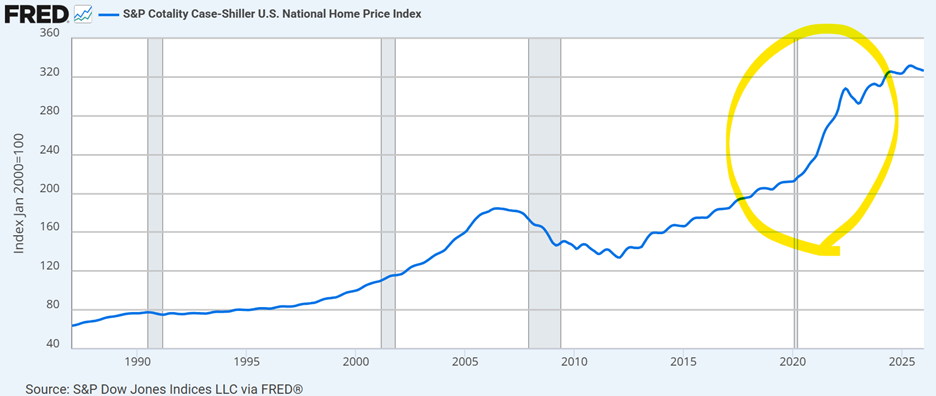
Real estate costs more to build due to inflation, so it makes sense that existing real estate would increase in value.
This same pattern played out in many commercial real estate sectors.
- Industrial
- Apartments
- Manufactured housing
- Shopping centers
- Healthcare
- Timberland
- Farmland
- SFR
These are the main sectors in which REIT Total Return is invested, and the physical real estate of each sector has clearly gone up in value. It is demonstrable with actual property transactions that have and continue to take place.
Yet somehow, REIT market prices didn’t get the memo.
The pricing disconnect is not a quality issue. The REIT’s properties operate with metrics that are superior to those of the broader asset class
So, while the assets themselves are hedges against inflation, public market investors seem to care more about the Fed than the assets the companies own.
Each time a hot inflation report comes out, the market worries that the chances of a Fed cut have gone down, rather than simply realizing that real estate is inherently an inflation hedge. It is largely via this mechanism that public and private prices of real estate have diverged to such a degree.
It is rare to be able to get high quality REITs at 78% of NAV. We are buying and intend to profit from the difference as the gap eventually closes.
Beyond the NAV disconnect, there are 2 main strategic plays in RTR:
- Overlooked growth
- Yield backbone
Overlooked growth
The market has a tendency to be myopic or even backward-looking. If a REIT did not experience strong AFFO growth in 2024, 2025 and/or 2026, the market deems it a low growth REIT and almost universally trades it at a low AFFO multiple.
While at a very superficial level, the market may be right that certain REITs have not been growing quickly, the folly is in assuming a straight line.
REITs have so many niche property sectors, each with its own unique fundamentals and its own cycles. Sometimes, a REIT that hasn’t grown well the past few years may indeed be a low growth REIT.
However, there are plenty of instances in which the low growth of recent periods is the result of a specific timing factor, which, upon resolution, will unlock much stronger growth going forward. In such instances, they are actually medium-to-high growth REITs being improperly valued as low growth.
Shopping centers are a clear example. AFFO/share growth for the sector has been relatively weak in the past few years, often in the 1%-3% range.
Why?
It is a matter of timing. A lot of leases rolled over, which means incurring significant TI and LC (tenant improvement costs and leasing commissions). Both of these detract from AFFO. Many of the leases signed commence at a later date, often somewhere around 6 months after the signing.
In exchange, the REITs are getting much higher rents, maybe 20%-45% higher than previous rent.
The pain points are felt immediately in AFFO (SNO leases don’t hit cash NOI until they commence and TI is often amortized), while the higher rent is felt over the duration of a ~10-year lease.
The higher revenues are contracted; they just haven’t fully filtered into AFFO/share. This delta in timing means AFFO has been slow, yet there is strong visibility into faster AFFO/share growth going forward. I think the market is significantly underestimating the forward growth of shopping center REITs.
Apartments have a similar timing issue with heavy supply hitting in recent periods, resulting in poor rent growth in 2025 and likely again in 2026. Longer term, however, rents are substantially below equilibrium, such that rent will naturally rise around 20% as supply cools off.
There is already significant cooling in supply with the forward construction pipeline at anemic levels. As demand catches up, rent growth will return and AFFO/share growth along with it.
Industrial, as a sector, is a bit bifurcated right now, with almost all of the new supply being big boxes over 100,000 square feet. As a result, the big footprint warehouses are having significant vacancy problems. We believe smaller footprint products are better positioned and have selected investments accordingly.
The Yield Backbone
Since stocks tend to rise over time and the timing of upswings is hard to predict, one is usually best served by staying fully invested. At RTR, we abide by this principle, largely staying fully invested.
One of the challenges of already being fully invested is that it is difficult to buy more shares when opportunity increases. For example, it is fully rational to buy a stock at 90% of estimated fair value. For whatever reason, that stock might then drop to 80% of fair value. One would want to buy more at the now even greater opportunity, but how do you buy more if you were already fully invested?
This is where the yield backbone comes in. RTR owns quite a few dividend-focused REITs. Its holdings produce annual dividends equal to 10.6% of initially invested capital.
These dividends provide a continuous cashflow which affords buying more shares as opportunity increases. It creates a compounding effect where we continually own more real estate, which in turn generates more and more cashflows.
Wrapping it up
RTR is positioned in strong property sectors with stocks that are trading well below asset value. We believe attaching to fundamental healthy properties at discounted prices is a great setup as valuations eventually normalize. As we wait for prices to approach fair value, we will continue to reposition opportunistically.
Evolving economies create opportunity
Our REIT Total Return Portfolio is actively managed to pivot into wherever the opportunity is greatest. We are now offering portfolio mirroring in which the trades in our REIT Total Return Portfolio are automatically executed in client portfolios simultaneously and at the same price.
Important Notes and Disclosure
Material Market and Economic Conditions. March 2022-2023: Significant increases in the Federal Funds Rate by the Federal Reserve have caused REIT market prices to decline more than the broader markets. REITs rely on debt financing to acquire properties and fund their operations; expiring lower-cost debt is being refinanced at higher interest rates due to prevailing market conditions. March 2020: REIT Total Return’s value declined substantially as COVID shut down the economy. It recovered in 2021 as the economy reopened. January 2019: Tax-loss selling’s calendar expired and the government reopened on January 25, 2019. The combined effect caused our shares to rise more than the broader markets. December 2018: Another Fed-Funds rate hike, unresolved US-Chinese trade, a partial government shutdown, and an exaggerated tax-loss selling season put extreme downward pressure on equity prices. All of these factors contributed to diminished liquidity and more significant share price declines in small-cap/value issues; REIT Total Return is focused on small-cap/value issues, so our decline was significantly more precipitous.
Material Conditions, Objectives, and Investment Strategies. REIT Total Return is an actively managed investment portfolio of real estate equities, primarily common and preferred shares of REITs, with an aim to generate high total returns from a mix of dividends and capital appreciation.
All REIT Total Return Portfolio performance information on this page is based on the performance of the Portfolio Manager’s account, using the manager’s own funds. Performance of the Portfolio Manager's account is calculated by Interactive Broker on a daily time-weighted basis, including cash, dividends and earnings distributions, and reflects the deduction of broker commissions (when commissions were charged). Actual client returns will differ. **2nd Market Capital’s advisory fees are simulated and applied retroactively to present the portfolio return “net-of-fees”.
None of the performance information displayed on this page is based on the actual performance of any 2MCAC client account investing in this portfolio. The performance in a 2MCAC client account investing in this portfolio may differ (i.e., be lower or higher) from the performance of the account managing this portfolio and portrayed on this page based on a variety of factors, such as trading restrictions imposed by the client (resulting in different account holdings), time of initial investment, amount of investment, frequency and size of cash flows in and out of the client account, applicable brokerage commissions (when commissions were charged), and different corporate actions. Clients investing in this portfolio may view the actual performance of their investment in this portfolio by logging into their Interactive Brokers account and reviewing their customized dashboard.
Clients may restrict any of the securities traded in their account but should note that any restrictions they place on their investments could affect the performance of their account leading it to perform differently, worse or better, than (a) the above-portrayed account or (b) other client accounts invested in the same portfolio.
Forward-looking statements. Commentary may contain forward-looking statements which are by definition uncertain. Actual results may differ materially from our forecasts or estimations, and 2MCAC cannot be held liable for the use of and reliance upon the opinions, estimates, forecasts, and findings in these documents.
Past performance does not guarantee future results. Investing in publicly held securities is speculative and involves risk, including the possible loss of principal. Historical returns should not be used as the primary basis for investment decisions. Although the statements of fact and data in this commentary have been obtained from sources believed to be reliable, 2MCAC does not guarantee their accuracy and assumes no liability or responsibility for any omissions/errors.
Use of Leverage or Margin. REIT Total Return Portfolio will utilize margin only for trading purposes (the ability to use the proceeds from stock sales immediately for new purchases instead of waiting for settlement), but not for borrowing purposes.
Benchmark Comparison. Our REIT Total Return Portfolio is compared to the Dow Jones Equity REIT Index and the MSCI U.S. REIT index because they are common REIT Indices. The Dow Jones Equity All REIT Index is designed to measure all publicly traded equity real estate investment trusts (REITs) in the Dow Jones U.S. stock universe. The MSCI US REIT Index is comprised of equity real estate investment trusts (REITs) eligible included within the eight Equity REIT Sub-Industries of the Equity Real Estate Investment Trust (REITs) Industry. It is not possible to invest directly in the Dow Jones Equity All REIT Index or MSCI US REIT index. Index returns do not represent the results of actual trading of investible assets/securities. Index returns do not reflect payment of any sales charges or fees an investor may pay to purchase the securities underlying the index. The imposition of these fees and charges would cause the actual performance of the securities to be lower than the Index performance shown. The results portrayed include dividend income. Our REIT Total Return Portfolio may include REITs that are not eligible for inclusion in the Dow Jones Equity All REIT Index or MSCI US REIT Index.
There can be no assurance that a benchmark will remain appropriate over time and 2MCAC will periodically review the benchmark’s appropriateness and decide to use other benchmarks if appropriate.
Expenses. Returns reflect the deduction of any transaction expenses. REIT Total Return's advisory fees are simulated and applied retroactively to present the portfolio return “net-of-fees”.
Calculation Methodology. Returns are calculated by 2MC with data from Interactive Brokers LLC using the Modified Dietz method, a time-weighted measure of performance in which cash flows are weighted based on their timing. Dividends in REIT Total Return are reinvested.
S&P Global Market Intelligence LLC. Contains copyrighted material distributed under license from S&P.
Discover more from 2nd Market Capital Advisory Corp
Subscribe to get the latest posts sent to your email.