
The State of REITs: May 2026 Edition
- The REIT sector roared back into positive territory after a very brutal March. REITs averaged a remarkable 8.9% April gain and now have a +6.31% year-to-date total return.
- Small cap REITs (+11.35%) soared in April as large caps (+9.05%) and mid caps (+8.13%) also saw strong gains. Micro caps (+4.49%) were also in the black but badly lagged their larger peers.
- 33% of REIT securities had a positive total return in April.
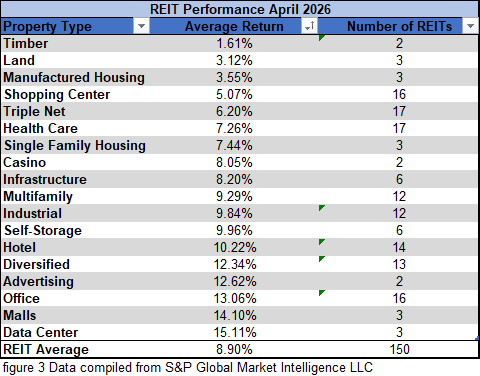
- Every single REIT property type averaged positive returns in April, led by Data Centers (+15.11%) and Malls (+14.10%).
- The average REIT NAV discount sharply narrowed from -17.81% to -10.73% during April. The median NAV discount similarly narrowed from -20.53% to -12.80%.
REIT Performance
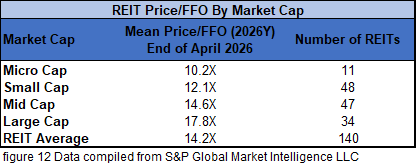
The REIT sector sharply recovered from an ugly March with a very strong 8.90% return in April. The REIT sector outpaced the Dow Jones Industrial Average (+7.2%) but fell short of the double-digit gains from the S&P 500 (+10.5%) and NASDAQ (+15.3%). The market cap weighted Vanguard Real Estate ETF (VNQ) fell slightly short of the average REIT in April (+8.60% vs. 8.90%) but has solidly outperformed year-to-date (10.03% vs. +6.31%). The spread between the 2026 FFO multiples of large cap (17.8x) and small cap REITs (12.1x) widened in April as multiples expanded 1.5 turns for large caps and 0.8 turns for small caps. Investors currently need to pay an average of 47.1% more for each dollar of FFO from large cap REITs relative to small cap REITs. In this monthly publication, I will provide REIT data on numerous metrics to help readers identify which property types and individual securities currently offer the best opportunities to achieve their investment goals.
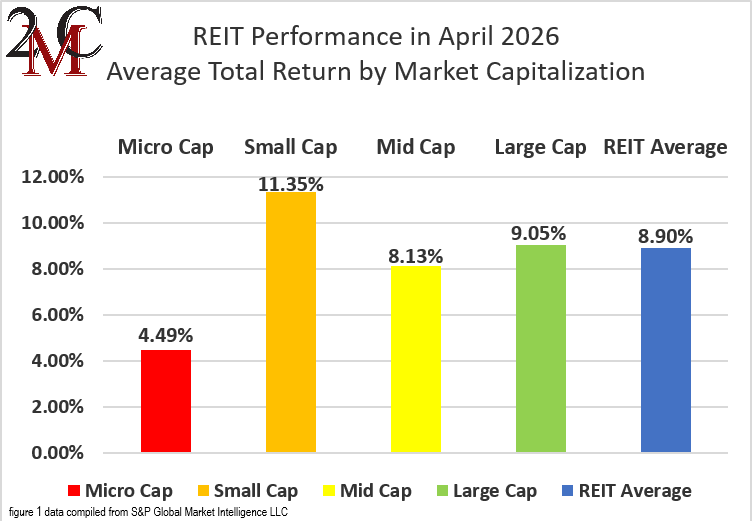
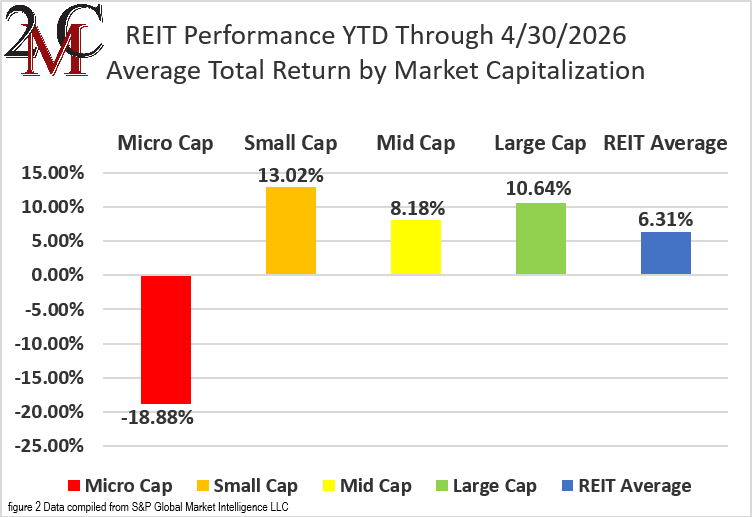
Micro cap REITs (+4.49%) finally spent a month in the black but continued to severely underperform their larger peers. Small caps (+11.35%) led the April surge followed by large caps (+9.05%) and mid caps (+8.13%). During the first four months of 2026, small cap REITs have outperformed large caps by 238 basis points.
Every Single REIT Property Type Averaged Positive Returns in April
100% of REIT property types averaged a positive total return in April, with a 13.49% total return spread between the best and worst performing property types. Timber (+1.61%) and Land (+3.12% saw the smallest gains, whereas Data Centers (+15.11%) and Malls (+14.10%) averaged strong double-digit returns in April.
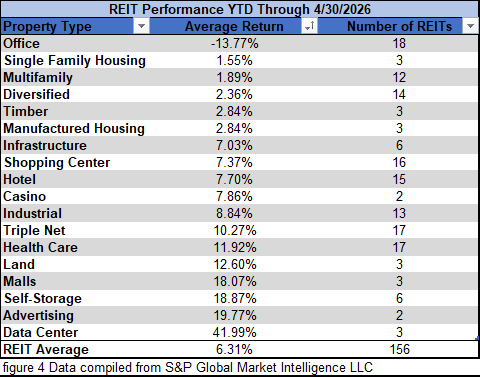
After a strong REIT recovery in April, Office (-13.77%) is the only property type in the red year-to-date. Data Centers (+41.99%) and Advertising (+19.77%) were the top performers over the first four months of the year.
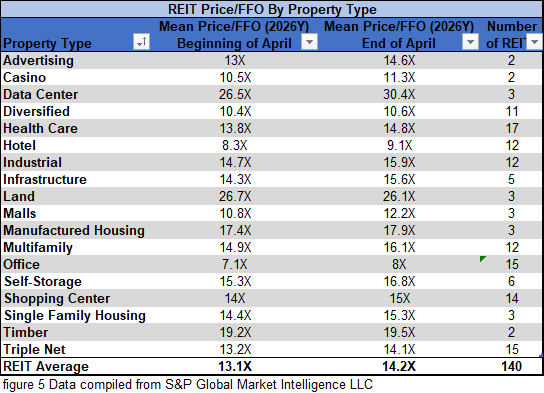
The REIT sector as a whole saw the average P/FFO (2026Y) increase from 13.1x to 14.2x during April. 94.4% of property types averaged multiple expansion, and 5.6% averaged multiple contraction. Data Centers (30.4x), Land (26.1x), Timber (19.5x) and Manufactured Housing (17.9x) currently trade at the highest average multiples among REIT property types. Office (8x) and Hotels (9.1x) are the only property types that average single-digit FFO multiples.
Performance of Individual Securities
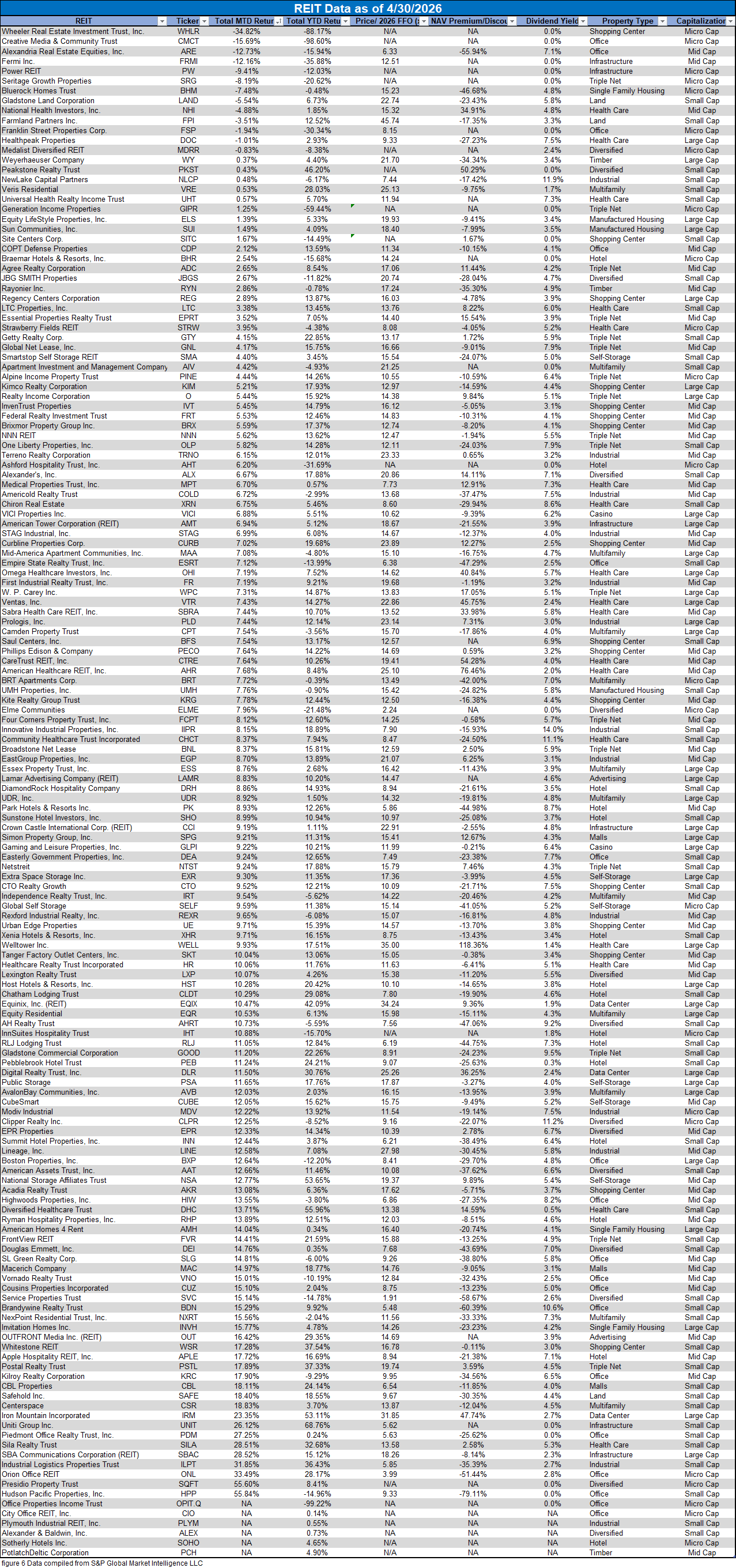
Hudson Pacific Properties (HPP) (+55.84%) was the best performing REIT in April, narrowly edging out Presidio Property Trust (SQFT) (+55.60%). HPP benefited from a strong month of share price recovery for Office REITs. After April’s bounce back, HPP now has a negative year-to-date total return of only -14.96%.
Wheeler REIT (WHLR) (-34.82%) continued its multi-year freefall in April, spending yet another month as the worst performing REIT. Wheeler now has the 3rd worst total return of 2026 with a year-to-date return of -88.17%.
A remarkable 91.33% of REITs had a positive total return in April. REITs have averaged a +6.31% year-to-date total return in 2026, far better than the -9.10% return for the REIT sector over the first four months of 2025.
Dividend Yield
Dividend yield is an important component of a REIT’s total return. The particularly high dividend yields of the REIT sector are, for many investors, the primary reason for investment in this sector. As many REITs are currently trading at share prices well below their NAV, yields are currently quite high for many REITs within the sector. Although a particularly high yield for a REIT may sometimes reflect a disproportionately high risk, there exist opportunities in some cases to capitalize on dividend yields that are sufficiently attractive to justify the underlying risks of the investment. I have included below a table ranking equity REITs from highest dividend yield (as of 4/30/2026) to lowest dividend yield.

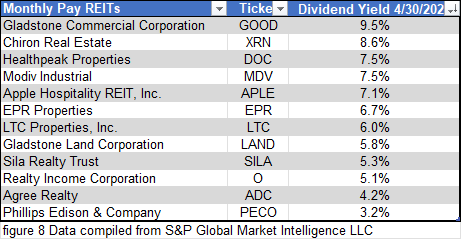
Although a REIT’s decision regarding whether to pay a quarterly dividend or a monthly dividend does not reflect on the quality of the company’s fundamentals or operations, a monthly dividend allows for smoother cash flow to the investor. Below is a list of equity REITs that pay monthly dividends, ranked from highest yield to lowest yield.
Dividend News
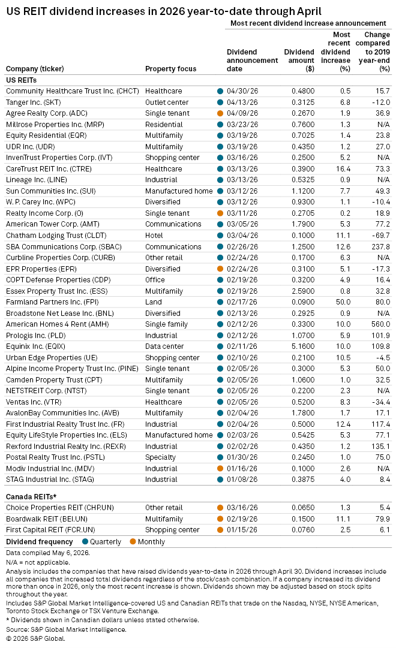
3 REITs increased their dividends in April, one of which is monthly and 2 of which are quarterly dividends. Over the first 4 months of 2026, 36 REITs have increased their dividends. The +6.8% dividend hike from Tanger (SKT) was the largest in April, followed by +1.9% from Agree Realty (ADC) and +0.5% from Community Healthcare Trust (CHCT).
Economic Health
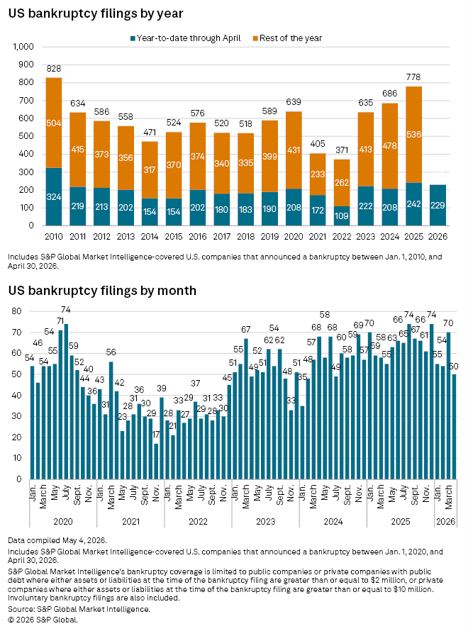
The number of corporate bankruptcies in April fell to the lowest monthly total since mid-2024, and 2026 has now seen fewer bankruptcy filings year-to-date than the first 4 months of 2025. That being said, bankruptcy filings remain elevated. There have been more 2026 bankruptcies year-to-date than in the first 4 months of any year from 2011 to 2024.
Valuation
REIT Premium/Discount to NAV by Property Type
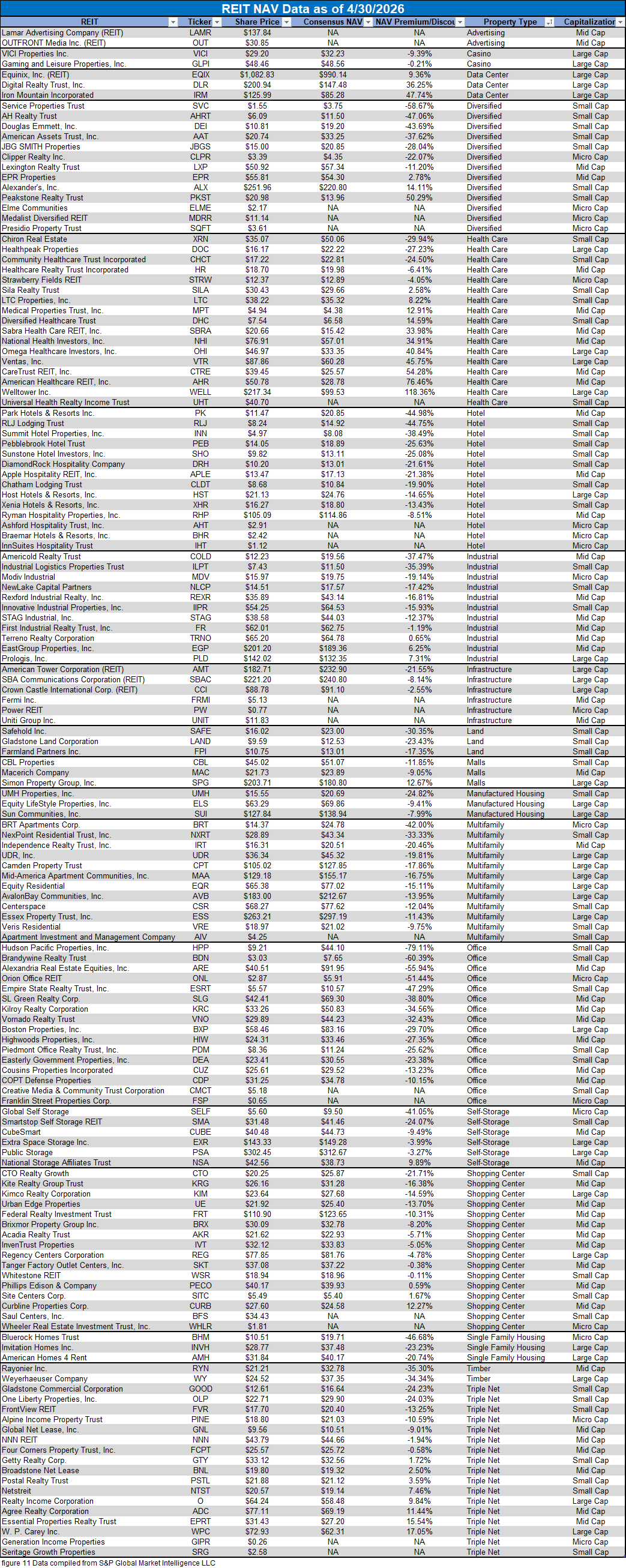
Below is a downloadable data table, which ranks REITs within each property type from the largest discount to the largest premium to NAV. The consensus NAV used for this table is the average of analyst NAV estimates for each REIT. Both the NAV and the share price will change over time, so I will continue to include this table in upcoming issues of The State of REITs with updated consensus NAV estimates for each REIT for which such an estimate is available.
Takeaway
The large cap REIT premium (relative to small cap REITs) widened yet again in April and investors are now paying on average about 47% more for each dollar of 2026 FFO/share to buy large cap REITs than small cap REITs (17.8x/12.1x – 1 = 47.1%). As can be seen in the table below, there is presently a strong positive correlation between market cap and FFO multiple.
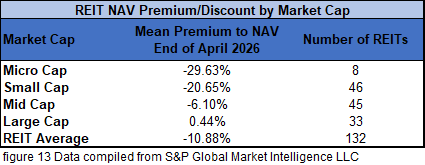
The table below shows the average NAV premium/discount of REITs of each market cap bucket. This data, much like the data for price/FFO, shows a strong, positive correlation between market cap and Price/NAV. The average large cap REIT (+0.44%) trades at a slight premium to consensus NAV. Mid cap REITs (-6.10%) trade at a single-digit discount. Small cap REITs (-20.65%) trade for about 4/5 of NAV, while micro caps (-29.63%) trade for a little over 1/3 of NAV.
The Majority of REITs raised 2026 Earnings Guidance, yet the Sector Trades at a double-digit discount to NAV
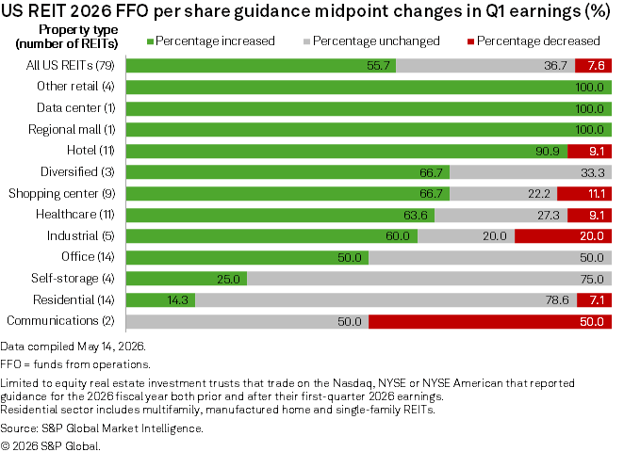
The REIT sector fundamentals appear to be broadly strong as a majority of REITs (55.7%) hiked their 2026 FFO/share guidance. This strength was further demonstrated by the fact that only 7.6% of REITs cut 2026 earnings guidance. Sectors that saw particularly strong guidance increases were Data Centers, Malls and Other Retail (Triple Net Retail), whereas the property types that saw the weakest earning guidance revisions were Communications REITs (0% increase / 50% reduction) and Residential REITs (14.3% increase / 7.1% reduction).
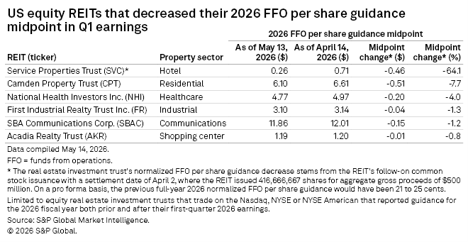
The most severe earnings midpoint FFO/share guidance reduction came from Service Properties Trust (SVC) with a -64.1% downward revision. Other REITs with material cuts to 2026 guidance came from Camden Property Trust (CPT) (-7.7%), National Health Investors (NHI) (-4.0%) and First Industrial Realty Trust (FR) (-1.3%). Despite the heavy downward reduction to FFO/share, however, CPT’s core FFO/share guidance remained unchanged.
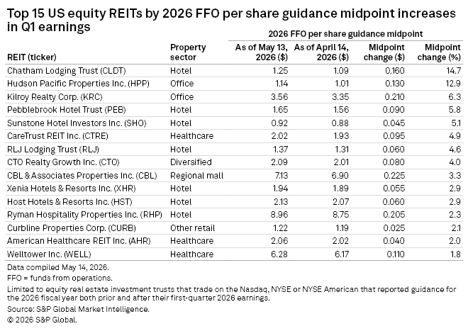
Both Chatham Lodging Trust (CLDT) (+14.7%) and Hudson Pacific Properties (HPP) (+12.9%) raised their guidance midpoint by double-digits. Overall, Hotels accounted for 7 of the 15 REITs with the biggest FFO/share guidance increases, with Pebblebrook Hotel Trust (PEB) (+6.3%), Sunstone Hotel Investors (SHO) (+5.1%) and RLJ Lodging Trust (RLJ) +4.6%) announcing strong increases to guidance at the midpoint.
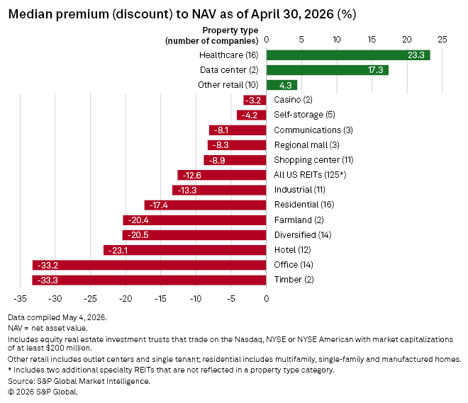
Despite strong fundamentals and rising earnings forecasts, the REIT sector remains heavily discounted. The property types with the largest NAV discounts are Timber (-33.3%), Office (-33.2%) and Hotels (-23.1%). Health Care (+23.3%), Data Centers (+17.3%) and Other Retail (+4.3%) are the only property types that trade at a premium.
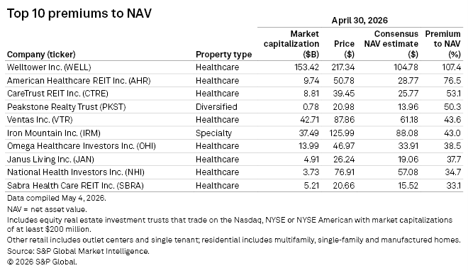
Health Care REITs account for 8 of the 10 largest NAV premiums led by Welltower’s enormous 107.4% premium. Other Health Care REITs with massive premiums are American Healthcare REIT (AHR) (76.5%), Ventas (VTR) (+43.6%) and Omega Healthcare Investors (OHI) (38.5%). The only REITs from other property types on the list at the end of April were Peakstone Realty Trust (PKST) (50.3%), which was delisted just days later in early May due to being acquired, and Iron Mountain (IRM) (43%), which has risen sharply in recent months due to very strong earnings growth.
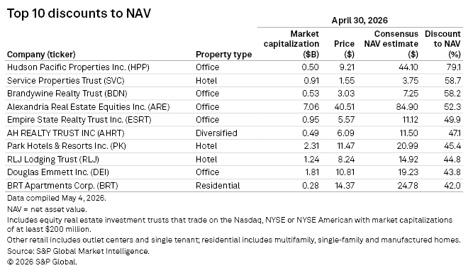
Office and Hotel REITs account for 80% of the 10 largest NAV discounts in the REIT sector. Even after a huge recovery and being the best performing REIT in April, HPP remains the furthest below NAV at a 79.1% discount. Service Properties Trust (SVC) (-58.7%), Brandywine Realty Trust (BDN) (-58.2%) and Alexandria Realty Trust (ARE) (-52.3%) also trade for less than half of their respective net asset values.
The REIT sector is well-positioned to potentially achieve a strong total return over the upcoming years as fundamentals continue to move in a positive direction and share prices remain largely below fair value. While not all REITs are attractively priced, there is a large pool of REITs that are currently trading at wide discounts to NAV while simultaneously performing well at the property level and raising guidance. Some of these quality discounted REITs will get snatched up via acquisition, and others will see their share prices get bid up toward and potentially even above fair value. Investors in the right REIT securities have multiple potential pathways to profitability through the remainder of 2026 and beyond.
Important Notes and Disclosure
All articles are published and provided as an information source for investors capable of making their own investment decisions. None of the information offered should be construed to be advice or a recommendation that any particular security, portfolio of securities, transaction, or investment strategy is suitable for any specific person. The information offered is impersonal and not tailored to the investment needs of any specific person.
We cannot determine whether the content of any article or recommendation is appropriate for any specific person. Readers should contact their financial professional to discuss the suitability of any of the strategies or holdings before implementation in their portfolio. Research and information are provided for informational purposes only and are not intended for trading purposes. NEVER make an investment decision based solely on the information provided in our articles.
We may hold, purchase, or sell positions in securities mentioned in our articles and will not disclose this information to subscribers, nor the time the positions in the securities were acquired. We may liquidate shares in profiled companies at any time without notice. We may also take positions inconsistent with the information and views expressed on our website.
We routinely own and trade the same securities purchased or sold for advisory clients of 2MCAC. This circumstance is communicated to our clients on an ongoing basis. As fiduciaries, we prioritize our clients’ interests above those of our corporate and personal accounts to avoid conflict and adverse selection in trading these commonly held interests.
Past performance does not guarantee future results. Investing in publicly held securities is speculative and involves risk, including the possible loss of principal. Historical returns should not be used as the primary basis for investment decisions. Although the statements of fact and data in this report have been obtained from sources believed to be reliable, 2MCAC does not guarantee their accuracy and assumes no liability or responsibility for any omissions/errors
Commentary may contain forward-looking statements that are by definition uncertain. Actual results may differ materially from our forecasts or estimations, and 2MCAC and its affiliates cannot be held liable for the use of and reliance upon the opinions, estimates, forecasts, and findings in this article.
Through October 2021, The State of REITs was published exclusively on Seeking Alpha by Simon Bowler, Sector Analyst at 2nd Market Capital Services Corporation (2MCSC). Editions subsequent to October 2021 will be published on this website in addition to other platforms that may include Seeking Alpha. 2MCSC was formed in 1989 and provides investment research and consulting services to 2nd Market Capital Advisory Corporation. 2MCSC does not provide investment advice. 2MCSC is a separate entity but related under common ownership to 2nd Market Capital Advisory (2MCAC), a Wisconsin registered investment advisor. Simon Bowler is an investment advisor representative of 2MCAC. Any positive comments made by others should not be construed as an endorsement of the author's abilities to act as an investment advisor.
S&P disclosure: S&P Global Market Intelligence LLC. Contains copyrighted material distributed under license from S&P.
Discover more from 2nd Market Capital Advisory Corp
Subscribe to get the latest posts sent to your email.